CELLFOOD®: composition and characteristics

CELLFOOD®: composition and characteristics
CELLFOOD® Solution stands out for its complex formulation combining minerals and trace elements, amino acids, enzymes and electrolytes, along with an exclusive formulation called Deutrosulfazyme®.
This composition is linked in particular to the use of Lithothamnium calcareum, a marine seaweed naturally rich in minerals.
On this page, we take a closer look at what’s in CELLFOOD® and where the different elements in its formulation come from.
What’s in CELLFOOD® Solution?
The original CELLFOOD® formula includes:
78 minerals and trace elements in trace amounts
34 enzymes
17 amino acids
electrolytes
seaweed extracts, including Lithothamnium calcareum
Deutrosulfazyme®, the exclusive formulation at the heart of CELLFOOD®
This combination forms the basis of CELLFOOD® Solution and is also at the heart of the different variations developed from the original formula.
Lithothamnium calcareum
Lithothamnium calcareum is a calcified red marine seaweed that naturally concentrates the various minerals found in its environment.
Its structure is particularly rich in calcium and also contains many other minerals and trace elements.
This mineral richness is why Lithothamnium calcareum is used in the CELLFOOD® formulation.
Unlike some other seaweeds, its composition is mainly characterized by its mineral fraction.
Minerals and trace elements
CELLFOOD® contains a wide range of minerals present in very small amounts.
These include calcium, magnesium, sodium, potassium, iron, copper, manganese, zinc and selenium.
Some of these elements are present in ionic form and can therefore behave as electrolytes.
Electrolytes are minerals that carry an electrical charge when dissolved in a liquid. They’re naturally involved in many of the body’s physiological processes.
However, the presence of an element in CELLFOOD® doesn’t necessarily mean it’s present in a nutritionally significant amount: the formulation is characterized above all by the diversity of elements present in trace amounts.
17 amino acids
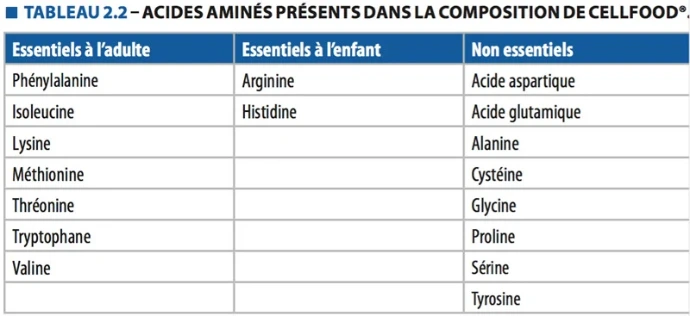
CELLFOOD® also contains 17 amino acids.
Amino acids are molecules naturally present in the body. They’re the basic building blocks used to make proteins.
The amino acids listed in CELLFOOD®’s composition include several essential amino acids, which the body can’t produce in sufficient quantities on its own and which normally have to come from the diet.
The presence of these different amino acids contributes to the formula’s particularly diverse composition.
Text
34 enzymes
The CELLFOOD® formulation also includes 34 enzymes.
Enzymes are molecules, usually proteins, that are naturally involved in a great many biochemical reactions.
In CELLFOOD®, they’re part of the set of components, alongside minerals, trace elements and amino acids, that make up the original formulation.
Deutrosulfazyme®, at the heart of the formula
Deutrosulfazyme® is one of CELLFOOD®’s distinctive features.
This exclusive formulation originally stems from Everett Storey’s work on water, deuterium and the mechanisms that release oxygen and hydrogen.
According to the principle developed by CELLFOOD®, Deutrosulfazyme® interacts with water and is involved in a process that releases oxygen and hydrogen.
Its name refers to the elements around which this formulation was developed: deuterium, sulfate and enzymes.
A unique manufacturing process
CELLFOOD® is made using a specific process in which the formula’s components are gradually combined.
Documents on the CELLFOOD® formulation describe a nine-month manufacturing process, at the end of which the formula used in CELLFOOD® Solution is obtained.
Along with Deutrosulfazyme®, this process is one of the historical features of the formula developed from Everett Storey’s work.
→ Discover the story of CELLFOOD®
To learn more:
The mineral composition of Lithothamnium calcareum
The table below shows the wide variety of elements found when analyzing Lithothamnium calcareum.
Please note: these values reflect the analyzed composition of Lithothamnium calcareum, not the quantitative composition of the finished product CELLFOOD® Solution.
| Element μg/g | Element μg/g | Element μg/g |
| Hafnium < 0.03 | Gallium 2.48 | Copper 4.89 |
| Aluminum 291.00 | Germanium 0.21 | Rhenium < 0.05 |
| Antimony 6.74 | Indium 0.05 | Rhodium < 0.01 |
| Silver 0.25 | Iodine 32.80 | Rubidium 1.95 |
| Arsenic < 0.20 | Iridium < 0.05 | Ruthenium 0.09 |
| Barium 64.2 | Ytterbium 0.10 | Samarium 0.53 |
| Beryllium 0.31 | Yttrium 1.22 | Scandium 0.04 |
| Bismuth 0.08 | Lanthanum 0.37 | Selenium 0.67 |
| Boron 39.50 | Lithium 2.77 | Silicon 504.00 |
| Bromine 10.10 | Lutetium 0.06 | Sodium 4.15 |
| Cadmium 0.07 | Magnesium 25.80 | Strontium 1.81 |
| Calcium 351.50 | Manganese 57.50 | Thallium 0.09 |
| Carbon 122.00 | Mercury < 0.01 | Tantalum 0.06 |
| Cerium 2.17 | Molybdenum 0.05 | Tellurium 0.05 |
| Cesium 0.10 | Neodymium 0.03 | Terbium 0.03 |
| Chlorine 910 | Nickel 1.48 | Tin 0.20 |
| Cobalt 0.08 | Niobium 0.14 | Titanium 27.8 |
| Chromium 0.82 | Holmium < 0.05 | Thorium < 0.02 |
| Dysprosium 0.08 | Gold < 0.01 | Thulium 0.06 |
| Erbium 4.27 | Osmium < 0.05 | Tungsten 0.19 |
| Europium 0.05 | Palladium < 0.01 | Vanadium 37.50 |
| Iron 915.00 | Lead 0.16 | Zinc 15.8 |
| Fluorine 7.28 | Platinum < 0.01 | Zirconium 0.34 |
| Phosphorus 310.00 | Potassium 5.18 | Sulfur 5.70 |
| Gadolinium 0.11 | Praseodymium 0.23 |
Above all, this analysis illustrates the mineral diversity of Lithothamnium. It shouldn’t be used to work out the quantities present in a dose or a bottle of CELLFOOD®.
One formula, several variations
The original formula is the starting point of the CELLFOOD® range. It was later combined with other ingredients in different products to meet specific needs.
To start with the original formula and discover its features, how to use it and directions for use:
→ Discover CELLFOOD® Solution